

Ultreia!
“You don’t choose a life, you live one.” Daniel Avery
It was a year ago that I took my first steps on a solo journey that would challenge and subsequently change how I saw myself. Just for context, I am someone who, previous to this trip had been out of the county 2x in my entire life (not including Canada which is sort of international). I’m not a big fan of: (a) flying (unless sedated), (b) doing activities I’ve never done before, (c) really any kind of travelling and (d) especially navigating through unfamiliar places. I can get lost finding my way back to my table from the restroom in a restaurant just to give a frame of reference. So I had this idea that wouldn’t it be an incredible way to celebrate my 65th birthday…..to fly to a country where I’ve never been, one where I don’t speak the language, and must navigate through the backwoods of the countryside carrying a carefully packed backpack…. alone? Because if you’re going to leave your comfort zone, you might as well shove it off a cliff. Even though I tried my best to talk myself out of it, I couldn’t get it out of my mind. Here’s now this whole thing started…..
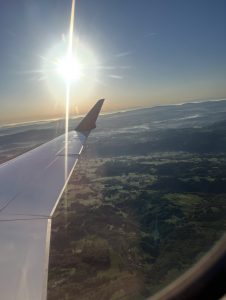 Nearly two years ago I was at a Fourth of July party. I was catching up with friends I hadn’t seen in a while. I asked one of them what he had been up to, and he casually told me he had just returned from a month-long nearly 500 mile walk across Spain. As one does lol. I was fascinated by his story and had to read more about it. Unbeknownst to me, what he described is a famous pilgrimage, known as El Camino de Santiago (The Way of St. James). It has multiple routes known as “Ways” (e.g. the French Way, the Northern Way) all over Europe, that converge in Galicia, Spain at the Cathedral of Santiago de Compostela. It is a pilgrimage site of historical significance that dates to medieval times. Over the centuries, for some this is a Christian pilgrimage to the burial site of St. James the apostle. For others, like me, it is a pilgrimage of a more general spirituality, connecting with nature and oneself. “The Way”, or the path, part literal, mostly metaphoric.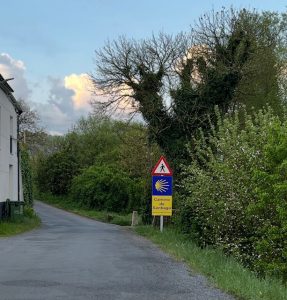
If you’re a hard-core Peregrino, (Spanish for pilgrim) you might start in Saint-Jean-Pied-de-Port, France and hike over the Pyrenes Mountains at your own risk, camp out under the stars every night and carry everything you need on your back the entire time. I admit, I, like many took a shortened route through Galicia and did not pitch a tent or sleep outside at night. That would have been a stretch for a me, with not a lot, ok, zero camping experience or skills. I would dare say, most people opt to sleep indoors at inns or Albergues (pilgrim hostels). I booked my trip for April which gave me seven months to research, prepare, take an elementary Spanish class…and ruminate. Before I knew it, it was April and I packed my carefully researched two pairs of hiking pants, five merino wool shirts, two pairs of hiking shoes, socks, underwear, jacket, hydration system, a multi-purpose bar of soap that served as detergent, shampoo and body wash, blister management supplies, and a hat. And then I went. After the first few days of my body screaming at me, something shifted. Not dramatically—just enough. The resistance softened and I adapted.
 One of the first surprises—aside from the fact that I was actually doing this—was the landscape. Northern Spain in April is lush, green, and stunning. I had expected something more arid and sunbaked, which shows how geographically challenged I am. (It’s like being surprised that the landscape in NY and FL is different.) The shades and textures of rolling hills, green meadows with mountains as the backdrop and dense forests really did take my breath away.
One of the great symbols of the Camino, the yellow arrow (La Flecha), always showing the way especially at times you think you are lost (a common theme for me). You can see them on milage markers, signs, hand-painted on stones, buildings, through the wooded areas, through more modern towns, through medieval villages built of stone. These arrows have guided thousands and thousands of Pilgrims over the course of the past nearly 1500 years, and I felt a mind-blowing collective consciousness with the people who have walked down these same paths, for whatever their reason, since the 9th century. I was so struck with awe to be reminded of the vastness of time.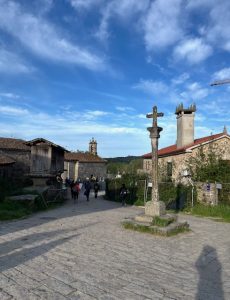
I loved how each town I stayed in had such a different vibe. The farmlands between Sarria and Ferreiros. Scaling down steep beds of rock outside Portomarin (one slip and my pilgrimage would have shifted from reflective journey to an emergency airlift situation), Melide, famous for its pulpo (octopus), a Galician delicacy, hearing bagpipes in the dense woods near O Pedrouzo which is a reminder of the deep Celtic roots in Galician culture.
 Somewhere along the route, in the small town of Palas de Rei, I had just begun to feel, perhaps prematurely, like someone who could handle uncertainty with a certain ease. Then the power went out. Not locally. Nationally. Spain, Portugal, parts of France and Germany—dark, disconnected, and entirely off the grid.
My mind, of course responded with a curated list of worst-case scenarios. Meanwhile, the town itself adopted a different posture altogether. I stepped into a small shop where the owner listened to a battery-powered radio. With my limited Spanish and her limited English, we arrived at a shared understanding: yes, the power was out everywhere, and no, this was not cause for alarm. She shrugged gently, as if to say, eh, this too will pass, likely by morning.
And that was the prevailing attitude. No urgency, no visible panic—just a quiet acceptance of the situation as it was. No internet, no phone service, no refrigeration, no hot meals…like a true pilgrim. I shared and traded food with other pilgrims who were staying at the same inn. It was a moment of camaraderie and a subtle but pointed lesson. We are so dependent on these systems we barely notice until they fail. And when they do, our instinct is to escalate before fully understanding the problem. In Palas de Rei, I saw an alternative: observe, adapt and wait. (And be grateful you were not in a large city where there was a bit of mass confusion.)
 I met so many amazing people. Three women in their late 70s from Canada who had been friends since they were in elementary school, a man with his 9-year-old son, pushing an enormous cart of clothing and bedding, three new friends from Michigan on a journey of faith and gratitude. In the end, I walked 90 miles. So, it was supposed to be 60-70 miles, but I chose to walk to and from some of the inns that were well on the outskirts of the trail and I admittedly (and not surprisingly) took more than a few non-intentional mega-detours trying to find these inns off the beaten path. But it was always worth it with scenery that never disappointed. And yes, 90% of the people you encounter will say “Buen Camino” as you pass by.
One of the traditions of the Camino is to leave a stone somewhere along the Way that represents a burden that you carry. It can also be placed to honor people in your life, either living or deceased. A few weeks before leaving for Spain, I found a perfect heart-shaped stone at the foot of my basement stairs. So of course it would be the rock that I carried. Somewhere along the miles, I was able to work through some last bits of grief. When I reached Santiago I left my stone and grief in a garden along with a quiet blessing for the people in my life who have loved and supported me. It was the perfect ending, but not really an ending.
 I wish this was some beautifully written story that weaves in every poignant aspect of the Camino…..but there are countless books and movies that do that in a much more poetic way than I can. What I hope to convey is simpler: the realization that the limits we assign ourselves are often more pliable than we imagine. We become accustomed to them, have attachments to them, even defend them, until something—like a conversation at a summer party—invites us to reconsider.
I started my journey with a lot of questions. But I returned with a clear answer. Stop dwelling on what I think I can’t do—why even create that list—but instead focus on what might be possible if I’m willing to find out.
I’ll land the plane explaining the title of this post, “Ultreia” It’s a less common, yet just as meaningful greeting on the Camino, and is medieval Latin translating to “onward and keep rising” Today, it’s a quiet kind of encouragement: Keep moving forward. You’re probably on the right path more than you think, especially on the days you accidentally take a scenic detour into uncertainty.
Til next time.